Creating a Trust in Your Will vs. Creating a Living Trust: Part 2
July 02, 2026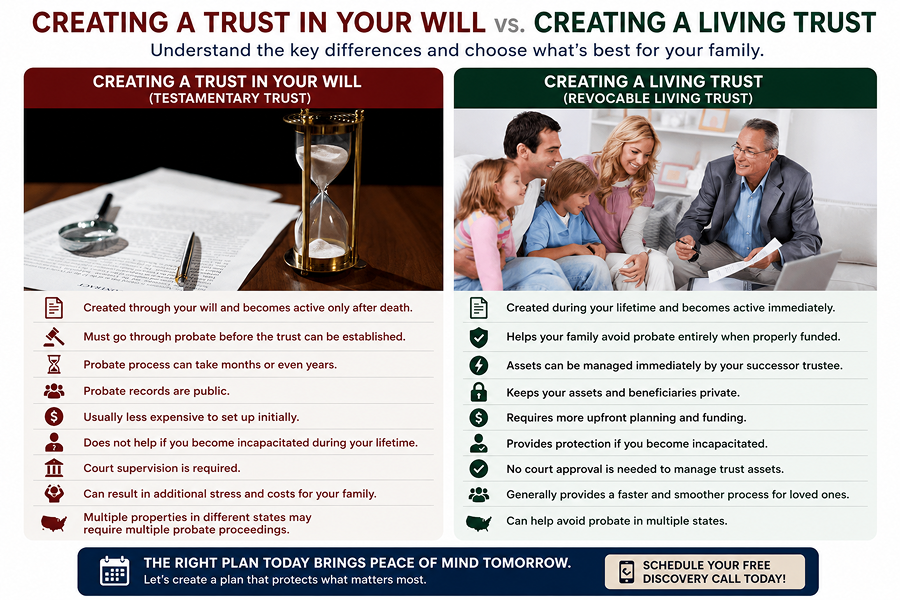
A living trust can provide immediate protection and help your family avoid probate, but understanding how it works and whether it fits your goals is essential if you want to make the right choice.
Last week, we covered what happens when you create a trust through your will. This week, I will explain how a trust created during your lifetime, called a revocable living trust, works differently, what your family experiences when you have one in place, and how to decide which approach truly fits your needs.
As a quick refresher, a testamentary trust is created through your will and does not come into existence until your estate goes through probate. That means your family may wait many months, and sometimes even years, while the court oversees the process of probating your will and establishing the trust. If your goal is to keep your family out of court and maintain privacy after incapacity or death, a testamentary trust will not achieve that.
A living trust, created during your lifetime and properly funded, can help your family stay out of court, preserve privacy, and generally make life much easier for the people you love when something happens to you.
In this article, I will explain how living trusts provide those benefits, help you think through the tradeoffs between the two approaches, and show you how to make a more informed decision.
How a Living Trust Works
A living trust, often called a revocable living trust, is created and funded while you are alive and legally able to make decisions. You transfer ownership of your assets into the trust during your lifetime and name yourself as the initial trustee. That means you keep full control while you are living. You can buy or sell property, manage investments, and handle your assets just as you always have. The trust does not take control away from you.
The trust agreement also includes detailed instructions for what should happen to those assets if you die or become incapacitated. Within the trust, you name a successor trustee, the person who will step in to manage the trust assets when you can no longer do so yourself. You can specify who receives trust assets, when they receive them, and under what conditions. Any protective terms you might include in a testamentary trust can also be built into a living trust.
The key difference between a living trust and a testamentary trust is this: when you die or become incapacitated, the living trust already exists and already owns the assets that were transferred into it. Your successor trustee does not need court approval to begin managing those assets. There is no probate filing, no waiting for a judge, and no public disclosure of your property or beneficiaries. The successor trustee simply follows the instructions you have already set out in the trust agreement.
This means your family can avoid the delay, cost, and public nature of probate. Your trustee can start paying bills, managing property, and distributing assets according to your instructions right away. If your trust includes provisions to protect a child’s inheritance until a certain age, those protections can begin working immediately. Your family receives the benefit of your planning when they need it most.
A living trust also helps if you become incapacitated before you die. If illness, injury, or cognitive decline leaves you unable to manage your affairs, your successor trustee can step in and act for you without requiring your family to go through a court guardianship proceeding. The person you chose can immediately take on the role you created for them.
However, there is one very important limitation. A living trust controls only the assets that are actually transferred into it. In estate planning, this is called funding the trust, and it is a step many people overlook, even when they work with a lawyer. If you create a living trust but never retitle your house or move the proper accounts into the trust, then those assets are not covered. When you die, those assets may still have to go through probate. A trust can control only what it owns.
That is why working with a lawyer who has clear systems and processes for estate planning, and ideally Life & Legacy Planning®, is so important. Preparing the trust document is only the first step. It should be part of a complete plan that covers all your assets, makes sure titles are handled properly, reviews and updates beneficiary designations, and helps you keep everything current over time. We have systems in our office designed to support exactly that.
Now that you understand how both types of trusts work, the next question is which one makes sense for your situation.
Understanding the Real Tradeoffs
If living trusts offer so many benefits, why would anyone choose a testamentary trust instead? The main reason is usually upfront effort and cost. A testamentary trust is often less expensive to set up initially because it is simply included within your will. You do not have to retitle assets or transfer them into a trust during your lifetime. All of that happens later, through the probate process after you die.
For some people, the potential cost of probate may not seem high enough to justify the upfront expense of creating and funding a living trust. Others may simply not be concerned about probate at all.
But it is important to think about the hidden costs your family may face. Even a straightforward probate typically involves several thousand dollars in court costs and legal fees. It often takes at least a few months, and in many cases much longer. Your family has to deal with all of this while grieving, gathering documents, speaking with attorneys, and carrying the stress that comes with the process.
Compare that with the experience of a properly funded living trust. Your family works with the successor trustee, who already knows your wishes. Together, they can handle immediate needs, notify beneficiaries, and begin carrying out your instructions. The process remains private, usually moves faster, and does not require court involvement. For many families, that is a far less stressful and ultimately less expensive experience than probate.
You should also consider your family dynamics. If you have relatives who may challenge your wishes, the public nature of probate can encourage disputes. Probate files are open to the public, which means anyone can see what you owned and who you left it to. A living trust keeps that information private, which can help reduce conflict.
It is also important to look at the nature of your assets. If you own real estate in more than one state, your family could be forced into probate proceedings in each of those states. A living trust that holds those properties can avoid that problem. If you own a business, probate delays may disrupt operations. A living trust can allow management to continue more smoothly.
Understanding these tradeoffs helps clarify which option fits your life. But you do not have to figure that out by yourself. Work with an experienced attorney who also serves as a trusted advisor and who can help you look at your specific circumstances so you can feel confident you are doing the right thing for the people you love.
How I Help You Create a Plan That Actually Works
At Phoenix Law, we do not push everyone toward the same kind of trust. Instead, we begin by helping you understand what would actually happen if you became incapacitated or when you die, based on your family dynamics and the assets you own. We walk you through the real costs, the likely timeline, and the actual experience your loved ones may face. Then we help you evaluate what matters most so you can make an informed decision that fits both your goals and your budget.
If a living trust makes sense for your situation, we do not simply prepare the document and send you on your way. We help you fund the trust properly, making sure assets are titled correctly and nothing important is missed. We also help keep your plan up to date during your lifetime, so you continue to have support when life changes.
Most importantly, we are there for your family if you become incapacitated or after you are gone. That ongoing relationship makes a meaningful difference. Your loved ones are not left trying to figure everything out alone. They have a trusted advisor who knows you, understands your wishes, and can guide them when you no longer can.
To learn more about how we can assist you and your loved ones, schedule a FREE discovery intake call using our online form, or call 501 300 7526 (PLAN) to schedule your FREE discovery intake call.
This article is a service of Phoenix Law, your trusted Arkansas Life & Legacy Planning and Arkansas estate planning attorneys in Sherwood, Arkansas. We do more than draft documents. We help you make informed and empowered decisions about life and death, for yourself and the people you love. That is why we offer a Life and Legacy Planning Session, during which you can become more financially organized than ever before and make the best possible choices for the people you love. You can begin by calling our office today to schedule a Life and Legacy Planning Session.
This material was created for educational and informational purposes only and is not intended as ERISA, tax, legal, or investment advice. If you are seeking legal advice specific to your needs, that advice must be obtained separately from this educational material.