Why Quick and Simple Estate Plan Reviews Don’t Exist
July 16, 2026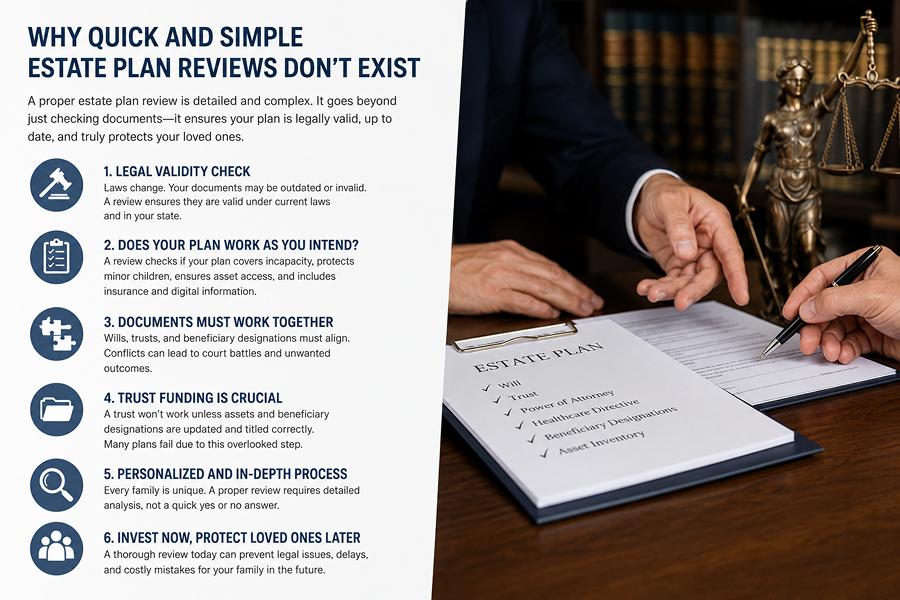
If your estate plan is several years old, or if you created it yourself, you may be tempted to call an attorney and ask for a quick, low cost review of your documents. On the surface, that may seem like a simple request. But the reality is that a proper estate plan review is, or at least should be, far more involved than most people expect.
When someone contacts an estate planning attorney asking for a “quick look” at their documents, the request usually sounds straightforward. Maybe the documents were created using an online service and they simply want reassurance that everything is in order. Maybe they moved to a different state and want to know whether the plan still works. Or maybe the documents are several years old and they are unsure whether everything is still valid. Most people hope for a yes or no answer, ideally during a short phone call or a quick, inexpensive consultation.
The truth is that there is no such thing as a simple document review in estate planning. What sounds like one straightforward question often opens up a wide range of legal, financial, and personal issues that must be analyzed carefully if you want to make sure your plan will not fail the people you love.
This article explains why an estate plan review requires more depth than many people realize, what a proper review actually involves, and why investing in that review now can save your loved ones from costly problems later.
The Hidden Complexity Behind Document Reviews
When someone asks an attorney to review estate planning documents, they are really asking several connected questions that all affect their future security and the protection of the people they love. Each of those questions requires careful attention, and overlooking even one of them can create a legal mess that is expensive and time consuming to fix later.
Here are some of the things an attorney should review:
1. Determine whether the documents are legally valid under current law and in your state.
State laws, federal laws, and tax laws change regularly. Documents that were valid when they were signed may no longer function as intended today, or they may never have been legally effective in the first place, especially if they were prepared without professional guidance. For example, many people do not realize that some banks and brokerage firms will refuse to accept a power of attorney that is more than three years old, and some may reject documents that are even newer. That can leave your loved ones unable to access your assets if you become incapacitated.
If you have moved from one state to another, an attorney may also need to analyze whether your existing plan still works under your new state’s laws and whether it still reflects what you want to happen.
Tax laws may also affect whether your current plan should be updated to make use of strategies that now apply to your estate.
In many cases, the time required to complete this type of review can cost as much, or more, than preparing a new plan from scratch.
2. Evaluate whether the plan actually does what you think it does.
Many people believe they have a complete estate plan when, in reality, they only have a set of documents with significant gaps. This is especially common when someone creates documents and assumes that means a full plan is in place. In most cases, that is simply not true.
A review may need to address questions such as:
- What happens if a primary beneficiary dies before you do, both under your documents and under any beneficiary designations
- Whether minor children are protected from receiving large inheritances before they are mature enough to manage them responsibly
- Whether the plan addresses incapacity as well as death
- Whether your loved ones will know where to find all of your assets so nothing gets lost
- Whether your loved ones will know how to access passwords and digital information
- Whether you have enough insurance to prevent financial hardship for your family
- Whether accounts will remain accessible after your death so bills can continue to be paid
And that is only a partial list. A proper review must look beyond the paperwork and into how your plan would actually function in real life.
3. Determine whether the documents work together as a true plan or create conflicts.
It is not unusual to find a will that says one thing, a trust that says something else, and beneficiary designations that contradict both.
When those conflicts exist, families may end up in court while a judge, who never knew you and does not understand your intentions, decides what you really meant. The result can leave no one satisfied, especially after years of stress and thousands of dollars in legal fees.
But even when documents are drafted correctly, the plan can still fail if one essential part of the process was never completed.
The Big Problem Nobody Talks About
There is one issue that surprises almost everyone: if you have created a trust, it will not work unless your assets were properly transferred into the trust and your beneficiary, TOD, and POD designations were correctly completed and kept up to date. In estate planning, this is called funding the trust, and it is where many trust based plans completely fail, even when the documents were prepared by a lawyer.
You can spend thousands of dollars on a will, trust, healthcare directive, and power of attorney, all placed neatly in a binder, and still end up with a plan that does not work because no one made sure your house, bank accounts, and investment accounts were properly retitled. The same problem happens when new assets are acquired later and never added to the plan. It is not just a question of titling. Beneficiary designations must also be reviewed regularly, and the assets themselves should be inventoried at least once a year.
Reviewing whether a plan is properly funded requires looking at title documents, account statements, beneficiary forms, and business documents. An attorney has to confirm that each asset is titled correctly and that every designation fits the overall plan. That is not something that can be done in five minutes. It requires a careful review of the entire financial picture.
Consider one common example: someone creates a trust with detailed instructions for how assets should be divided among family members, but their life insurance policy still names their spouse as the sole beneficiary. When they die, that life insurance payout goes directly to the spouse and never passes through the trust. The money may then end up with a future spouse or stepchildren rather than the children the trust was intended to protect. A proper review would have identified and fixed that conflict.
This is exactly why attorneys cannot responsibly offer quick, surface level reviews. Even when someone believes their circumstances are simple, the amount of time and care required is often much greater than expected.
Why Cutting Corners Creates Risk
When a person asks an attorney to “just quickly review” their documents, they are really asking for legal advice based on incomplete information. An attorney cannot responsibly do that. If an attorney says the plan looks fine after only a cursory review, and later serious problems are discovered, the result may be both harm to the family and a potential malpractice issue for the attorney.
More importantly, your loved ones could suffer financial and legal consequences that proper planning would have prevented.
An attorney’s professional responsibility requires either doing a thorough review or declining the review altogether. There is no responsible middle ground. That means the attorney must carefully examine the documents, ask questions about your assets and family dynamics, research how current law applies to your situation, and provide an informed analysis of the findings. That work takes time, experience, and cost.
While the price of a thorough review may feel higher than expected, it is small compared with what your family may face if an inadequate plan fails at the worst possible time. By then, it will be too late to fix.
What You Should Reasonably Expect
The cost of a comprehensive review may seem significant until you compare it to the cost of failure. Probate often costs thousands of dollars and can take a year or longer. Legal disputes between family members over unclear plans can cost tens of thousands. And the emotional toll of watching loved ones fight over an estate while grieving is impossible to measure.
If you want confidence that you have a complete plan that works for you and your loved ones, keeps them out of court and conflict, protects minor children, and helps avoid lost assets or financial instability, you should expect to invest at least $1,000 for a thorough plan review. That review should include an inventory of your assets, an understanding of what matters most to you, and a detailed analysis of your current documents, no matter how “simple” you believe your situation may be. In my experience, most people think their circumstances are easy, but that is rarely the case.
You should also expect to complete a questionnaire or some form of homework before meeting with the attorney. A proper review often requires the attorney to spend time preparing in advance, reviewing documents and financial statements, examining trust funding, meeting with you, and then offering guidance based on the full analysis. If changes or updates are needed, those would typically involve additional cost.
How We Support You and Your Loved Ones
A comprehensive review is not really about the documents themselves. It is about investing in peace of mind. It is about knowing your loved ones will be cared for according to your wishes without unnecessary legal complications, family conflict, or financial waste. It is about making sure no assets are lost, your family remains financially stable, your children are not left vulnerable, and your loved ones know what to do when the time comes.
To learn more about how we can assist you and your loved ones, schedule a FREE discovery intake call using our online form, or call 501 300 7526 (PLAN) to schedule your FREE discovery intake call.
This article is a service of Phoenix Law, your trusted Arkansas Life & Legacy Planning and Arkansas estate planning attorneys in Sherwood, Arkansas. We do more than draft documents. We help you make informed and empowered decisions about life and death, for yourself and the people you love. That is why we offer a Life and Legacy Planning Session, during which you can become more financially organized than ever before and make the best possible choices for the people you love. You can begin by calling our office today to schedule a Life and Legacy Planning Session.
This material was created for educational and informational purposes only and is not intended as ERISA, tax, legal, or investment advice. If you are seeking legal advice specific to your needs, that advice must be obtained separately from this educational material.